
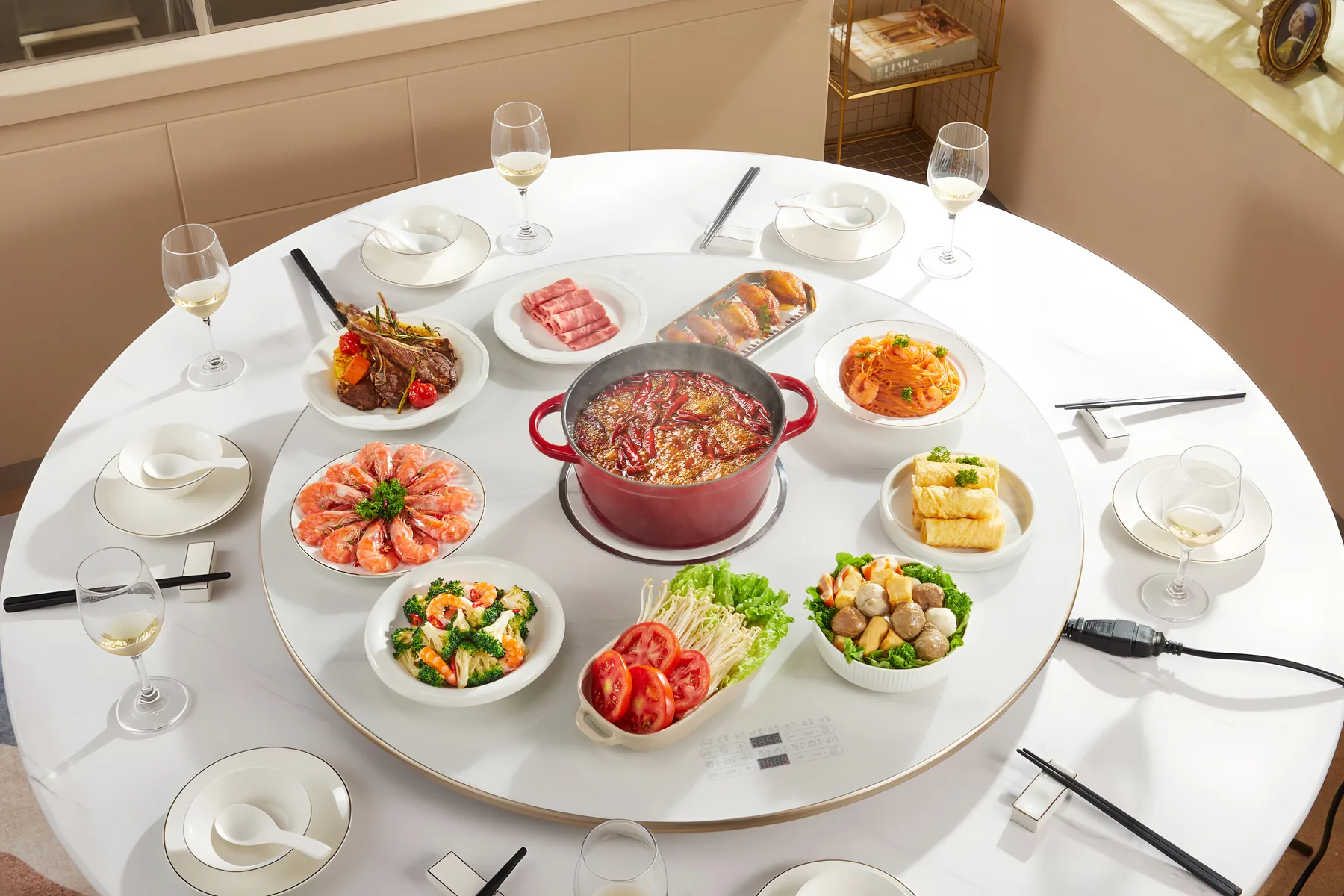
Quick Answer
To choose a warming tray temperature, first distinguish the displayed setting, the actual panel temperature and the food's core temperature. In ZVVEN's current manual, food-warming mode displays a range of 40—140℃, with a default of 100℃. The hot-pot function uses power settings of 200—3000W rather than temperature control. Adjustments depend on the food, dishes and operating time. The current website does not publish measured food core temperatures.
The numbers shown in the manual are operating settings. They do not automatically represent measured temperatures at every point on the panel, and should never be treated directly as food core temperatures.
Why This Happens
The same temperature question may refer to the control-panel display, a measurement point on the panel, the bottom of a plate or the inside of the food. Dish material, food moisture, placement, surroundings and operating time can all affect the result. ZVVEN's temperature uniformity test method page currently states that no verifiable test results or third-party reports are available. This article therefore cites only the manual's display ranges and does not infer actual food temperatures.
Understanding the Manual's Temperature Ranges
According to the currently published ZVVEN warming tray user manual (PDF), the food-warming, defrosting, wine-warming, drying, space-warming and gentle-stewing functions cycle through settings in 10℃ increments. The table below lists the initial display values and adjustable ranges in the manual, not measured panel or food core temperatures.
| Function in the manual | Initial display | Adjustable display range | Scope of the evidence |
|---|---|---|---|
| Food warming | 100℃ | 40—140℃ | Displayed setting; actual temperatures require corresponding tests |
| Defrosting | 70℃ | 60—90℃ | Does not establish the safety of food defrosting |
| Wine warming | 80℃ | 70—100℃ | Suitable containers and requirements for the beverage need separate confirmation |
| Drying | 45℃ | 35—55℃ | Follow the manual for suitable items and operating time |
| Space warming | 55℃ | 45—75℃ | A function name used in the manual; no other uses are implied |
| Gentle stewing | 50℃ | 40—70℃ | Suitability for particular ingredients requires information from the brand |
Choosing Settings for Keeping Food Warm and Reheating
| Use case | Available information to refer to | Still to be confirmed |
|---|---|---|
| Briefly keeping freshly cooked dishes warm | Select food-warming mode; the manual gives a default display of 100℃ and a range of 40—140℃ | Actual temperatures with different plates and foods need measurement |
| Serving several dishes in stages | Place dishes securely and keep the controls clear | Measured temperature differences between positions need to be provided by the brand |
| Food that has already cooled considerably | Current information describes only functions and setting ranges | Reheating performance and the time required need to be provided by the brand |
| Keeping food warm for extended periods | Record duration, load, settings and any abnormal conditions | Data on food temperature and quality changes need to be provided by the brand |
The displayed setting alone cannot establish whether food has reached a particular safe temperature. When needed, use a thermometer suitable for food to measure its core temperature and apply the relevant food-safety requirements. ZVVEN's website currently has no published test report of this kind.
Why the Hot-Pot Function Uses Power Rather Than Temperature
The manual gives hot-pot power settings of 200W, 800W, 1600W, 2200W and 3000W. Its hot-pot table also lists power settings and defaults for boiling water, steaming and stewing, stir-frying and soup-making. Power describes the rate of energy input, not the temperature inside the pot. Cookware, liquid volume, surroundings and boiling conditions all affect the resulting temperature.
| Hot-pot operating stage | Conditions to observe | What this article can establish |
|---|---|---|
| Starting to heat | Cookware compatibility, liquid volume and heating progress | Adjust the power settings as instructed; do not treat power as temperature |
| Reaching a boil | Adjust power to the condition inside the pot and avoid prolonged vigorous boiling | The appropriate setting depends on cookware and load |
| Continuing to cook hot pot | Maintain the required heating level and keep the appliance attended | Measured temperature-control data for different cookware need to be provided by the brand |
| Finishing use | Switch off and allow hot parts to cool | Follow the manual and safety warnings |
Use in Different Households and Table Settings
- A few dishes: Choose a size that fits your table and the number of dishes. Do not select a product simply for a high displayed temperature.
- Meals with more people: Consider dish placement and temperature differences across positions. Measured temperature-uniformity data currently need to be provided by the brand.
- Older adults and children present: Keep the appliance attended during operation and cooling. Children must not operate it alone or touch hot surfaces.
- Frequent hot-pot meals: First confirm that the selected product supports hot pot, that cookware is compatible and that the power supply is suitable. Interpret its controls as power settings rather than temperature settings.
- Frequent long meals: Monitor operating time, food condition and safety. A timer display in the manual does not prove performance during extended warming.
Choosing a ZVVEN Product
Temperature functions must be assessed for the specific product on sale. Visit the ZVVEN Product Center to explore the Marble White Series, Obsidian Black Series and Rosewood Wood-Frame Series. Choose according to table size, required functions, the product nameplate and its supplied manual. This article does not extend one series' display range to measured temperatures for all models.
Limitations and Safety Reminders
- The displayed setting is not the food's core temperature and cannot replace food-temperature measurement.
- Do not use the food-warming function for hazardous or experimental purposes not expressly supported by the manual.
- Place the appliance on a stable, dry, ventilated surface, away from damp surroundings and sources of fire.
- Do not let children use it alone. Avoid direct contact with hot surfaces during operation and cooling.
- Do not rinse directly with water or immerse the appliance. Disconnect power and allow it to cool before cleaning.
- Stop using the appliance immediately and contact after-sales service if the panel cracks, the power cord is damaged or anything abnormal occurs.
- See the warming tray safety guide and the official manual for the full requirements.
Frequently Asked Questions
1. If food-warming mode displays 100℃, is the food at 100℃?
No. 100℃ is the default display value in the manual. Food temperature also depends on the plate, food, position, surroundings and time, and must be measured.
2. What fixed temperature should I use to keep food warm?
The current manual gives a food-warming display range of 40—140℃ and a default of 100℃. No single setting suits every dish. Adjust it according to the cookware and the condition of the food.
3. Can a warming tray thoroughly reheat food that has gone cold?
The website currently provides no verifiable test results for specific foods, loads and durations. Measured reheating performance and food core temperatures need to be provided by the brand.
4. What temperature should I set for hot pot?
The manual's hot-pot function uses power settings from 200W to 3000W, not temperature settings. Adjust them according to cookware, liquid volume and actual boiling conditions.
5. Does the displayed temperature prove that food is being held safely?
No. Actual food temperature requires core-temperature measurement and assessment against applicable food-safety requirements. The website currently has no published report for this test.
6. Will several plates in different positions have the same temperature?
A temperature-uniformity test is needed to determine this. The current page publishes a test method only, without measured temperature differences for each size and measurement point.
7. Can it run continuously for a long time?
Follow the specific product manual, monitor operating conditions and on-site safety, and keep it attended. Data on temperature drift and food quality during extended warming need to be provided by the brand.
8. When can I clean it after use?
Switch off, unplug and allow the product to cool before cleaning it appropriately. Do not rinse it directly with water or immerse the body.
Sources and Last Update
Sources: ZVVEN warming tray user manual, temperature uniformity test method, heating speed test method, safety guide and current ZVVEN product pages. Article publication and source review date: 2026-08-30.