
Quick Answer
Tableware compatibility depends on where it is placed, how that area heats and how the tableware may be used. Choose intact, stable, heat-resistant containers approved for contact heating for the outer warming area. If the central hot-pot zone uses induction, the pot base must also meet induction-cookware requirements. A ceramic plate suitable for warming must not automatically be moved to the center for cooking.
Warming and hot-pot cooking on the same tray may use different heating methods. Identifying your product version and its functional areas is more useful than simply remembering that ceramic or stainless steel is suitable.
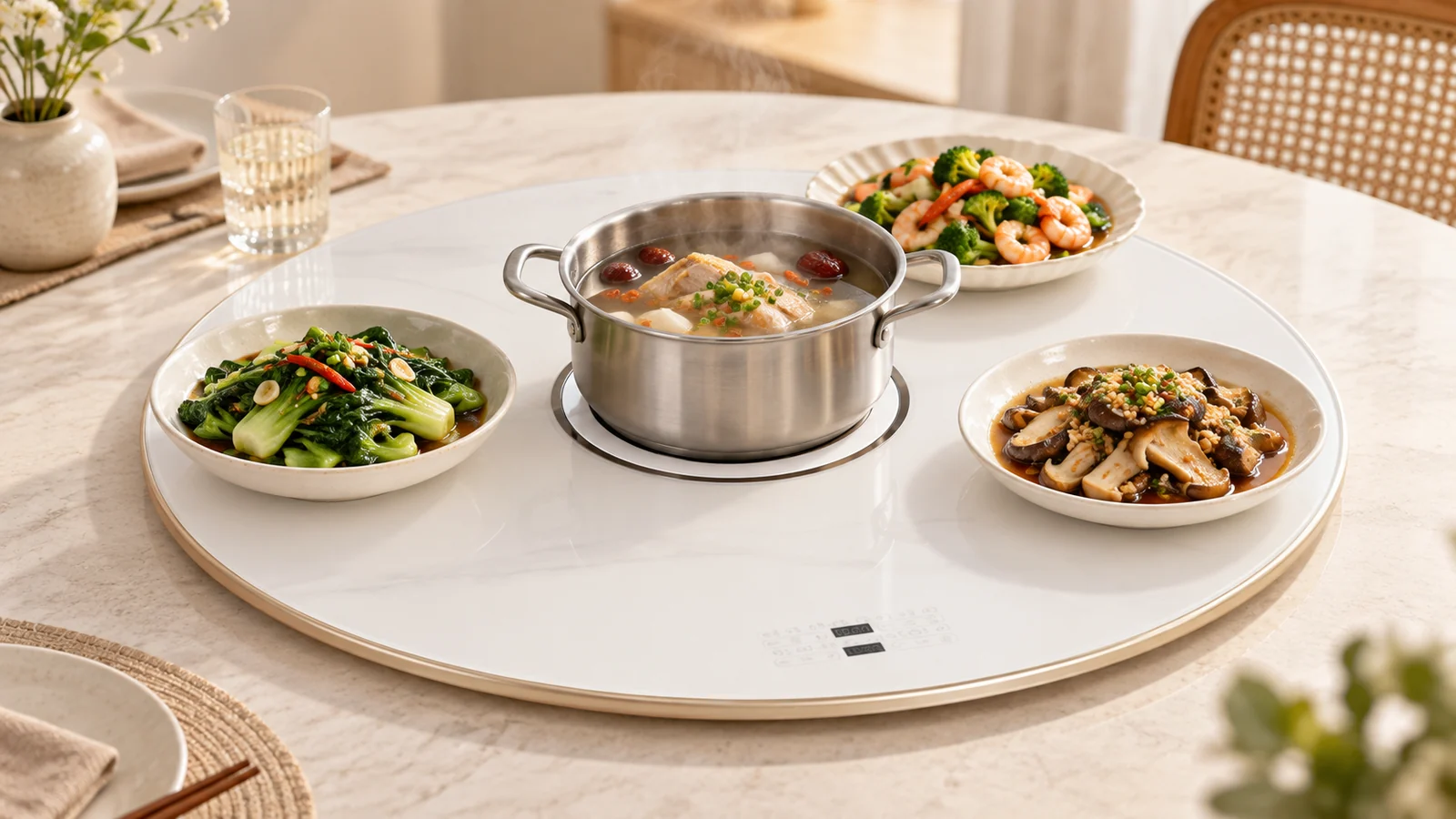
First, distinguish the warming area from the hot-pot zone
The outer warming area holds tableware containing cooked food and keeps dishes warm during the meal. Cookware in the central hot-pot zone must meet the requirements of that cooker. The same simple material rule cannot cover both areas, and instructions for the central zone do not apply to the entire panel.
In particular, distinguish induction models from radiant electric models. Induction requires a compatible pot base. For radiant electric heating, check the exact model’s manual; the description alone does not mean every pot is suitable. Check the rating label and supplied manual, or give customer support the model number. Do not judge by color or panel appearance alone.
What should you check for common types of tableware?
| Tableware type | In the outer warming area | In the central induction hot-pot zone |
|---|---|---|
| Ceramic bowls and plates | Check that this type of contact heating is permitted. The base should be stable and free of cracks; the word “ceramic” alone is not enough. | Ordinary ceramic plates are not induction cookware. Special composite-base containers need explicit compatibility instructions. |
| Glass containers | They must be explicitly suitable for the heating conditions. “Heat-resistant glass” or “microwave-safe” does not automatically mean warming-tray compatible. | Ordinary glass pots are not suitable for induction. Check separate instructions for products with special bases. |
| Stainless-steel pots and bowls | Check the intended use, base flatness and stability, including the permitted use of handles and lids. | Not all stainless steel is suitable. Confirm that the base is induction-compatible. |
| Cast-iron and enamel-coated pots | Check appliance load limits and cookware instructions. Lift and place gently instead of dragging across the panel. | Check compatibility markings, base size and flatness. Do not judge only by the outer enamel or coating. |
| Plastic food boxes and disposable containers | Do not heat directly on the warming tray without explicit suitability instructions. Transfer food to a compatible container first. | Do not use as cookware in the central induction hot-pot zone. |
The base is crucial for induction cookware. Bosch’s induction cookware guidance explains that cast iron, steel and some magnetic stainless steels can work with induction. Ordinary glass, aluminum or copper containers need a suitable magnetic base layer to be potentially compatible. This explains the heating principle; it does not certify compatibility for a particular ZVVEN model or pot.
Arrange your table in these three steps
- Read markings and instructions first. Check the warming tray’s model and functions, then the heating methods permitted for each pot and dish. A magnet sticking to a pot base is an initial clue for induction compatibility, but does not replace compatibility markings, base-size checks or cooker instructions.
- Check the base and overall condition. Containers must be undamaged and not noticeably deformed, with clean, dry bases. Do not keep using cracked plates or pots that rock when placed down. Do not place tableware straight from a cold environment onto an already heated panel without first confirming it is suitable.
- Place securely in the appropriate area. Center the pot according to its instructions. Leave space around outer serving dishes for handling, avoiding crowding, unsupported edges or covered controls. Dish bases must not straddle different functional areas, which could put warming-only tableware over a cooking zone.
What should you confirm when choosing tableware for ZVVEN?
Start with your selected series in the ZVVEN product center, then use the manual supplied with your appliance to confirm the central heating method, pot-base size and operation. The same color does not mean the same internal heating method, size or permitted load. Providing the product model and markings on the dish base makes an accurate answer easier than simply asking whether a plate will work.
Also check that the appliance stands securely, ventilation openings are clear and the power cord is not trapped by table legs or containers. See the warming tray safety guide for placement and electrical precautions.
Frequently Asked Questions
Does “microwave-safe” mean a plate can go on a warming tray?
Not automatically. Microwave heating and contact with a hot surface are different conditions. Check the tableware’s instructions for permitted heating methods; if unclear, ask its manufacturer first.
Can every stainless-steel stockpot go in the central induction zone?
Not necessarily. Compatibility varies with the steel and composite base. Check the induction-compatible marking, base size, flatness and the cooker’s requirements.
Is a larger central pot always better?
No. Base size and weight must be within the limits of the specific model. Leave room for outer dishes, controls and safe handling. Simply fitting on the surface does not establish compatibility.
Can an outer ceramic plate be moved to the center to heat faster?
Do not do this. The outer warming area and central hot-pot zone have different purposes. An ordinary plate does not become suitable cookware for the central cooker just because faster heating is wanted.
Sources and Scope
This article was checked on 2026-09-23 against the ZVVEN warming tray user manual, official safety guide and Bosch cookware guidance above. It distinguishes warming tableware from cooking vessels and does not replace a model-specific compatibility list. Follow the supplied manual and the tableware instructions.