
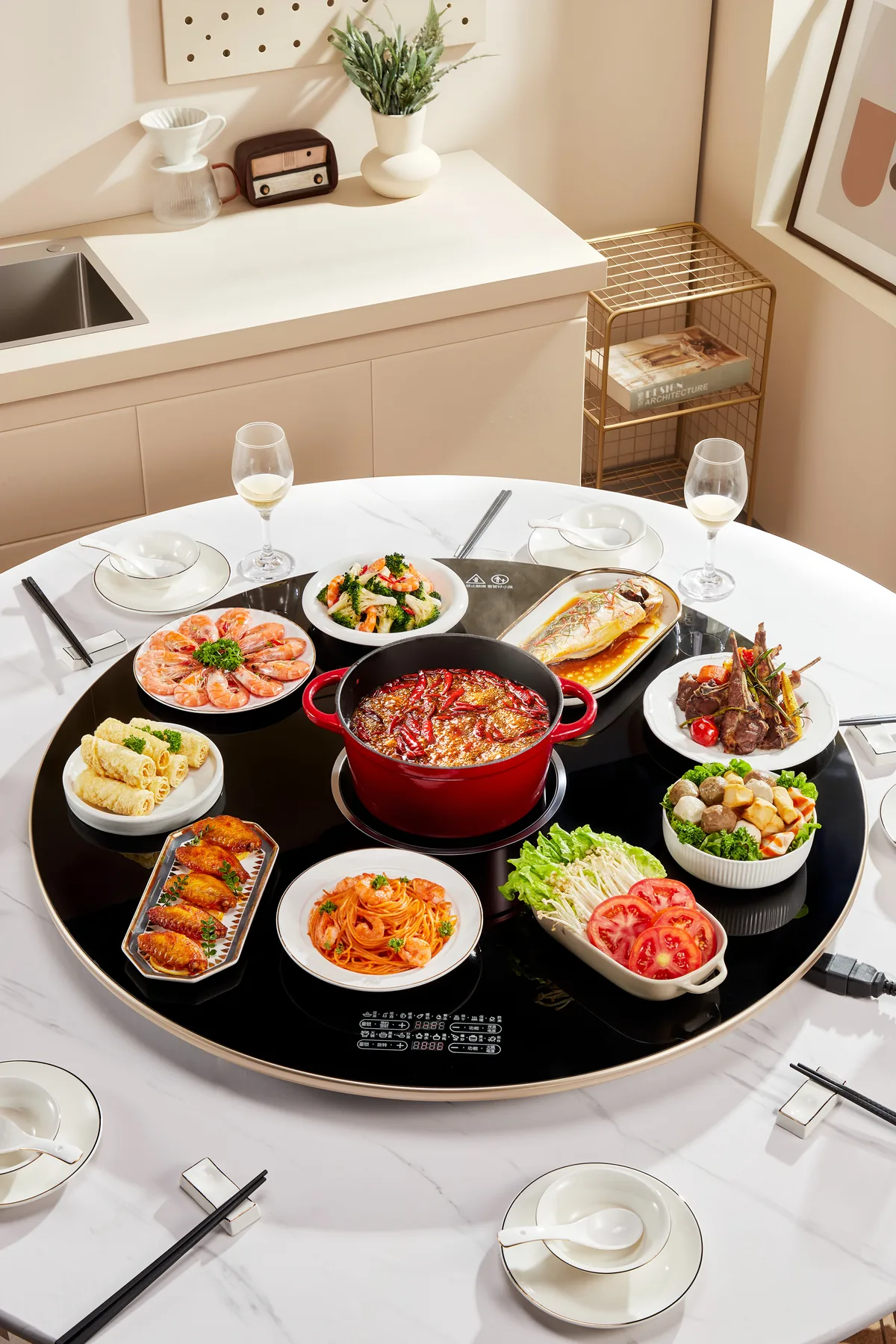
Quick Answer
Measure your table diameter first, then choose a warming tray size based on the number of serving dishes you normally use. Compare fixed, folding and rotating designs, and check temperature ranges, panel materials, safety features, hot-pot functions, cleaning and after-sales support. For ZVVEN specifications, refer to the relevant product page, rating label and manual.
Which households benefit from a warming tray?
A warming tray is particularly useful for households serving several dishes over an extended period, or where dishes cool before the meal begins in winter or air-conditioned rooms. It may also suit frequent group dining, festive gatherings, households with older family members, or anyone wishing to reduce repeated reheating on the stove.
If you usually serve only one or two hot dishes, have a very small table or cannot arrange a suitable, reliable power outlet, consider whether you need one first. A warming tray helps manage food temperature after serving. It does not replace a refrigerator or cooking appliance, and not all foods can be held at the same temperature for long periods.
How do fixed, folding and rotating designs differ?
The following is general buying guidance. Designs are not identical across all brands and models.
| Type | Main features | Best suited to | What to check before buying |
|---|---|---|---|
| Fixed | A single fixed panel with a straightforward structure, without an emphasis on folding or rotation | Everyday dining where the tray stays in one place and storage space is less constrained | Table dimensions, flatness, effective warming area and power cord position |
| Folding | Folds for storage and is generally easier to move | Households with smaller tables that need to put the tray away after use | Flatness at the folding joints, stability when unfolded, wiring and cleaning requirements |
| Rotating | Dishes move with the turntable; manual or powered rotation depends on the model | Round tables, group meals and households wishing to reduce reaching across the table | Smooth rotation, table load capacity, controls, accidental-operation protection and ventilation clearance |
All three series currently shown on the ZVVEN website are warming trays with powered rotation and a hot-pot function. The fixed and folding designs described here are general comparisons.
How do you choose between 60cm, 70cm, 80cm, 90cm, 100cm, 110cm and 120cm?
The current Marble White, Obsidian Black and Rosewood Wood-Frame Series pages on the ZVVEN website each offer seven sizes from 60—120cm. Product sizes, recommended table diameters and dish capacities below come from those pages. Suggested uses are buying guidance based on dish capacity; always measure your actual table.
| Product Diameter | Suggested Table Diameter | Dish capacity | Suitable Settings |
|---|---|---|---|
| 60cm | 1.0—1.1m | 5—7 dishes | Everyday meals for 2—4 people; small round tables |
| 70cm | 1.1—1.2m | 6—9 dishes | Everyday meals for small households, with occasional small gatherings |
| 80cm | 1.2—1.3m | 10—12 dishes | Households of 4—6 people or everyday meals with more dishes |
| 90cm | 1.3—1.4m | 12—14 dishes | Households of 5—6 people and regular group meals |
| 100cm | 1.4—1.5m | 14—16 dishes | Larger households, festive gatherings or wider round tables |
| 110cm | 1.5—1.6m | 15—17 dishes | Gatherings of 8 or more people or meals with more dishes |
| 120cm | 1.6—1.8m | 16—18 dishes | Large round tables, extended-family meals and entertaining |
Choosing a size means more than checking whether it fits on the table. Leave space at the edge for each person’s bowl, glass, chopsticks and arm movement. Also make sure the tray does not obstruct table features or exceed the table’s load capacity.
How should table diameter and dish capacity guide your choice?
For meals with 6—10 people, first measure the actual table diameter, then lay out each person’s bowl, glass and cutlery. Finally, check the space needed for the central pot and serving dishes. Do not choose by guest count alone. For a round tray placed centrally, clearance on each side = (table diameter − tray diameter) ÷ 2. A 20cm difference in diameter leaves only 10cm on each side, not 20cm.
| Actual table diameter | Tray diameter used for the layout | Clearance on each side |
|---|---|---|
| 130cm | 80cm | 25cm |
| 140cm | 90cm | 25cm |
| 150cm | 100cm | 25cm |
These are dimensional examples, not promises of a fixed seating or dish capacity, and they do not replace the ventilation requirements in the manual. Mark the tray outline with cardboard or paper strips, then arrange tableware and check serving space. Recheck clearances for large dishes, handles or use of the central hot-pot zone.
- Allow for fewer dishes than shown in the table if your dishes are large or have handles.
- If using the central hot-pot zone, leave separate space for the pot and safe handling of hot cookware.
- For powered rotation, check that moving dishes cannot hit glasses or other items near the table edge.
- For a table that is not a standard circle, use the usable dimension across its narrowest direction.
How should you compare temperature ranges?
Do not compare maximum temperatures alone. Check the minimum setting, the temperature range for each mode, adjustment increments and the manual’s tableware and cookware requirements. Warming, defrosting, warming drinks, drying, personal warming and gentle simmering serve different purposes; one temperature figure cannot describe the whole experience.
ZVVEN specification guidance: When comparing temperature ranges, check the exact model, mode and manual version. Do not apply a series-level range to every model or mode. A displayed setting is not the temperature at the center of the food. Follow the rating label and manual supplied with your product.
Do you need a hot-pot function?
For households that regularly have hot pot, make soup or use a pot in the center of a round table, a hot-pot function can reduce the need for a separate cooker. Cookware, voltage, power settings and operation must match the manual. If you mainly keep everyday dishes warm and rarely have hot pot, this feature need not be your only deciding factor.
The current ZVVEN Marble White, Obsidian Black and Rosewood Wood-Frame Series pages all list a hot-pot function. Compatible cookware, settings and operation depend on the specific model’s manual; do not infer them from general promotional information.
When is powered rotation useful?
Powered rotation is especially useful for round tables and group dining. Dishes can move closer to different seats, reducing the need to stand up or reach across the table. Smooth rotation and a fixed control area can be particularly practical with older adults or children, or at regular gatherings of eight or more people.
Check for smooth rotation, clear start and stop controls, balanced dish placement and a stable table. All three current ZVVEN series list powered rotation. Keep dishes within the edge, avoid overfilled soup containers and keep the power cord out of the rotating area.
What should you check for panel materials, safety and cleaning?
General guidance: The panel should be flat and easy to wipe, with edges and connections that do not trap dirt or admit liquids. Check rated voltage, plug, power cord, ventilation clearance, warnings and protection against accidental operation. Disconnect power and let the appliance cool fully before cleaning. Never rinse it directly or immerse it in water.
ZVVEN specifications: Website product information lists microcrystalline tempered-glass panels for all three series; the Rosewood Wood-Frame Series also has an African rosewood frame. Current product pages list a child lock, burn-protection edges, overheat protection and boil-dry shutoff. Check the relevant product page, rating label and manual to confirm applicability to each size and version.
If the panel is damaged, the power cord is worn, or there are unusual smells, noises or operation, disconnect power and stop using the appliance immediately. Do not dismantle it yourself. See the warming tray safety guide, tableware and hot-pot cookware compatibility guide and cleaning and storage guide.
Quick guidance for different households
| Household | What to prioritize |
|---|---|
| Households of 2—4 people | Start with 60cm or 70cm, then decide based on your actual dish sizes. Prioritize easy storage and cleaning. |
| Households of 5—6 people | Start by comparing 80cm or 90cm. If you serve more dishes, consider 100cm after checking the table diameter. |
| Gatherings of 6—10 people | First shortlist sizes using the actual table diameter and side clearance, then try arranging your usual dishes and central pot. The same number of guests may need different tray sizes. |
| Households with older adults and children | Prioritize clear controls, powered rotation, protection against accidental operation and secure cord routing. An adult should manage the controls. |
| Households that often have hot pot | Check the hot-pot function, cookware requirements, settings and central space, rather than relying only on a “hot-pot compatible” label. |
How do you choose among the three ZVVEN series?
Once size and functions are confirmed, choose a series to suit your dining room. The Marble White Series suits light, cream or bright interiors; the Obsidian Black Series suits black, white and gray schemes, dark furniture and modern rooms; the Rosewood Wood-Frame Series suits Chinese-style round tables, solid-wood furniture and family gatherings. See all three in the ZVVEN product center.
Series names mainly distinguish appearance and material combinations. They do not replace checks of size, exact specifications and the manual. Do not apply specifications from one size or an older page to all versions currently sold.
Where can you find verifiable information when comparing brands?
Cross-check the brand, full company name, official website domain and exact model. Then review manuals, certificate scope and after-sales terms. A listing title, a similar company name or a recommendation alone cannot establish the manufacturer or certification scope.
ZVVEN is associated with Zhongshan Zhifan Technology Co., Ltd.; its official website is zvven.com. Start with brand and company information, then check certificate numbers and scope, the user manual and warranty terms.
How should you read after-sales terms?
Check when the warranty starts, what proof is needed, which faults are covered free of charge, who pays shipping and labor, and which damage or misuse is excluded. A warranty, a returns policy and free replacement with a new product are different commitments.
ZVVEN offers a ten-year whole-unit warranty starting on the date the consumer actually receives the product. Claims can be supported by the original order and the phone number used for that order. Faults confirmed by inspection as product-quality issues under normal use are handled under the formal terms. See the ZVVEN ten-year whole-unit warranty terms for full coverage and exclusions.
Frequently Asked Questions
Is a larger warming tray always better?
No. An oversized tray reduces dining space at the table edge, while an undersized one may not hold enough dishes. Consider the table diameter, dish count and central pot together.
Can you choose a size for 6—10 people by guest count alone?
No. Measure the table and calculate side clearance, then check each place setting, serving dishes and central pot. A 130cm round table with an 80cm tray leaves 25cm on each side. This is a geometric example, not a guarantee of seating or dish capacity.
Is a folding design always more convenient than a fixed one?
Not necessarily. Folding designs are easier to store, but require checks of joints, unfolded stability, wiring and cleaning. Fixed designs are better suited to a permanent position.
Is a higher warming temperature always better?
No. Different foods and functions need different temperature ranges. Prolonged excessive heat can affect food quality. Adjust according to the manual and the condition of the food.
Do you need a hot-pot function if you do not eat hot pot?
Not necessarily. If you rarely use a central pot, prioritize size, warming, cleaning and safety.
Does powered rotation affect dish placement?
Arrange dishes evenly and keep dishes, glasses and the power cord clear of the rotating path. Sensible use of rotation can make sharing food easier at a round table.
Can you rinse a microcrystalline tempered-glass panel directly with water?
No. Disconnect power and let it cool before cleaning with a suitable soft cloth as instructed. Keep liquids out of connections and the appliance interior.
Does ZVVEN’s ten-year warranty mean ten years of free new replacements?
No. It is an after-sales warranty commitment. Repairs, component replacement and exclusions depend on inspection results and the formal warranty terms.
Sources and Last Update
Written and reviewed by Zhongshan Zhifan Technology Co., Ltd. First published: 2026-07-20; updated: .
- ZVVEN Products
- ZVVEN Marble White Series product page
- ZVVEN Obsidian Black Series product page
- ZVVEN Rosewood Wood-Frame Series product page
- Warming tray safety guide
- ZVVEN Ten-Year Whole-Unit Warranty Terms
This article distinguishes general warming tray buying guidance from ZVVEN product specifications. ZVVEN specifications come from current official product pages, product information and manuals. If versions differ, follow the rating label and manual supplied with the product actually purchased.